
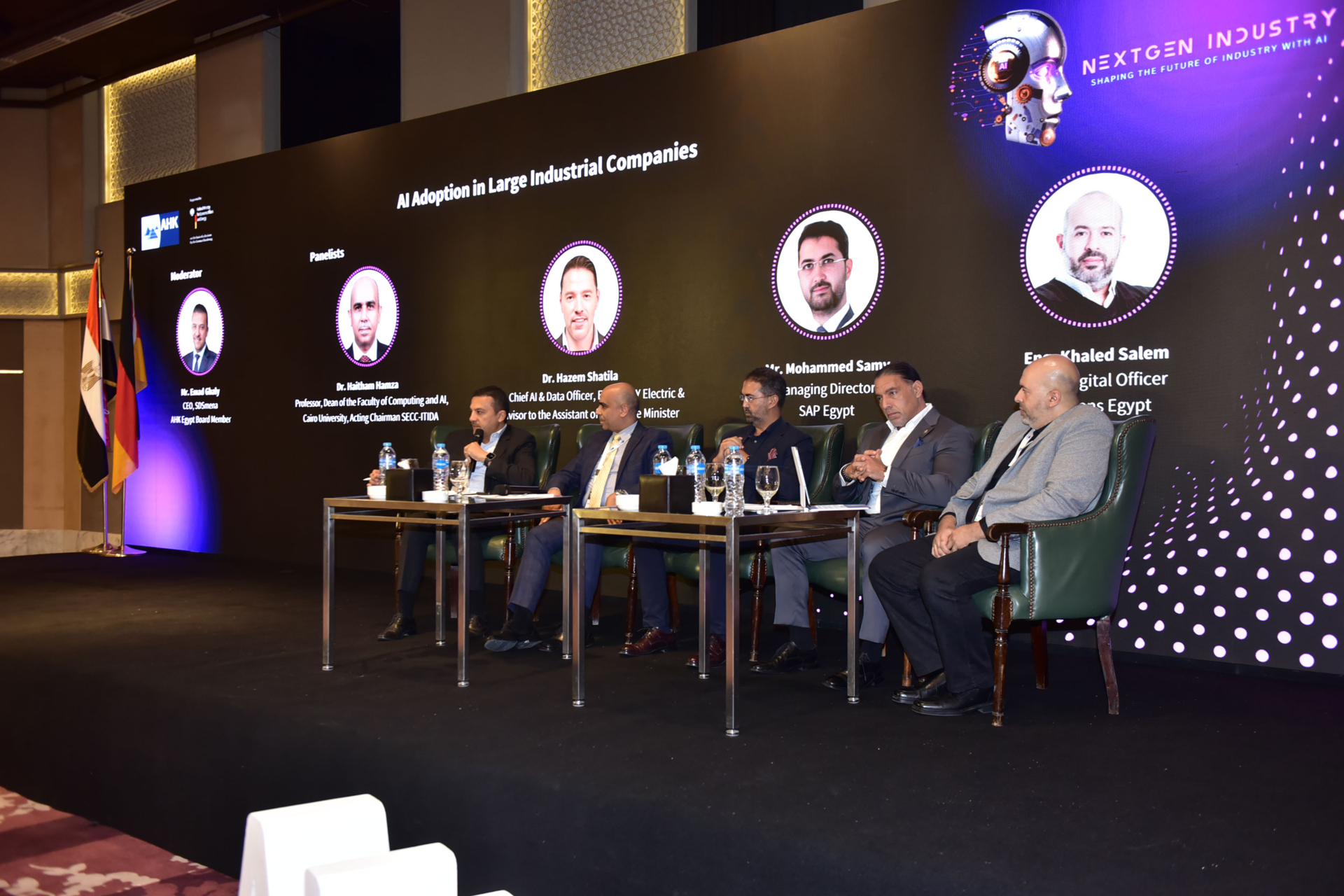
On 25th November 2025, I participated in an executive panel at the German-Arab Chamber of Industry and Commerce (AHK Egypt) during the NextGen Industry event. The session brought together leading figures from industry, academia, and global technology providers to reflect on how AI is reshaping Egypt’s economic direction and advancing the objectives of Egypt Vision 2030. The discussions highlighted both the opportunities and challenges facing organisations as they work to embed AI at scale. One message was clear: the success of AI initiatives depends on leadership mindset just as much as it does on technology.
1. Talent & Mindset: The Cornerstone of AI Readiness
AI transformation begins with people. The shift toward AI-enabled operations requires employees to understand, trust, and actively use intelligent systems.
- Continuous skilling, reskilling, and upskilling are no longer optional—they are essential investments for competitiveness.
- AI is influencing organisational culture, accelerating decision-making, and enabling new levels of efficiency across departments.
- The future workforce will be defined by augmented capability—individuals equipped with AI tools will outperform those who rely solely on traditional methods. As highlighted in the panel, “People using AI will outperform people who don’t.”
- Creating an AI-positive mindset reduces resistance and increases adoption, ensuring smoother integration of new systems.
2. Data & Infrastructure: Building a Scalable Foundation
Effective AI requires strong digital foundations. Without reliable data and modern infrastructure, organisations risk remaining stuck in pilot mode.
- Clean, consistent, and accessible data forms the backbone of any successful AI initiative. Data quality remains one of the biggest hurdles across industries.
- Many organisations already possess valuable operational data that can deliver immediate AI-driven insights—unlocking efficiency gains without major system overhauls.
- Infrastructure modernisation—cloud readiness, data platforms, connectivity, and compute—determines whether AI can scale from experimentation to enterprise-wide deployment.
- Companies that treat data as an asset and build strong governance frameworks will accelerate adoption and reduce implementation friction.
3. Leadership & Strategy: Turning AI Into Business Outcomes
AI is now firmly positioned as a board-level topic. Executives increasingly view AI not as an IT function but as a strategic capability that directly influences financial and operational performance.
- Leadership teams must continuously ask: “Where can AI create measurable value across the business?”
- Successful organisations ground AI initiatives in clear business outcomes—cost optimisation, revenue growth, operational excellence, and improved customer experience.
- Transformation requires long-term vision rather than isolated projects. Executive sponsorship, cross-functional alignment, and consistent communication are key enablers.
- Companies that embed AI into strategic planning will create durable competitive advantages and move beyond fragmented experimentation.
4. Measuring Value: Indicators of AI Maturity
Clear metrics enable organisations to track progress and justify further investment. AI is now evaluated using both financial returns and broader indicators of organisational readiness.
Key business metrics include:
- ROI on AI deployments
- Productivity gains across operations
- Energy efficiency improvements and cost reductions
- Decreased unplanned downtime and extended asset lifetime
Ecosystem-level maturity indicators are also emerging:
- A growing number of AI-driven startups entering the Egyptian market
- Industrial teams increasingly adopting AI to enhance performance and decision-making
- A visible shift from traditional, process-heavy operations toward intelligence-driven industry models
Together, these metrics reflect not only current benefits but also the trajectory of Egypt’s AI ecosystem.
Closing Perspective
AI is rapidly becoming a defining capability for industrial competitiveness. As Egypt progresses toward Vision 2030, organisations that invest in talent, strengthen their data foundations, modernise infrastructure, and embed AI into strategic
decision-making will lead the next phase of industrial transformation. The opportunity is significant—and the companies that act early will secure a long-term advantage.