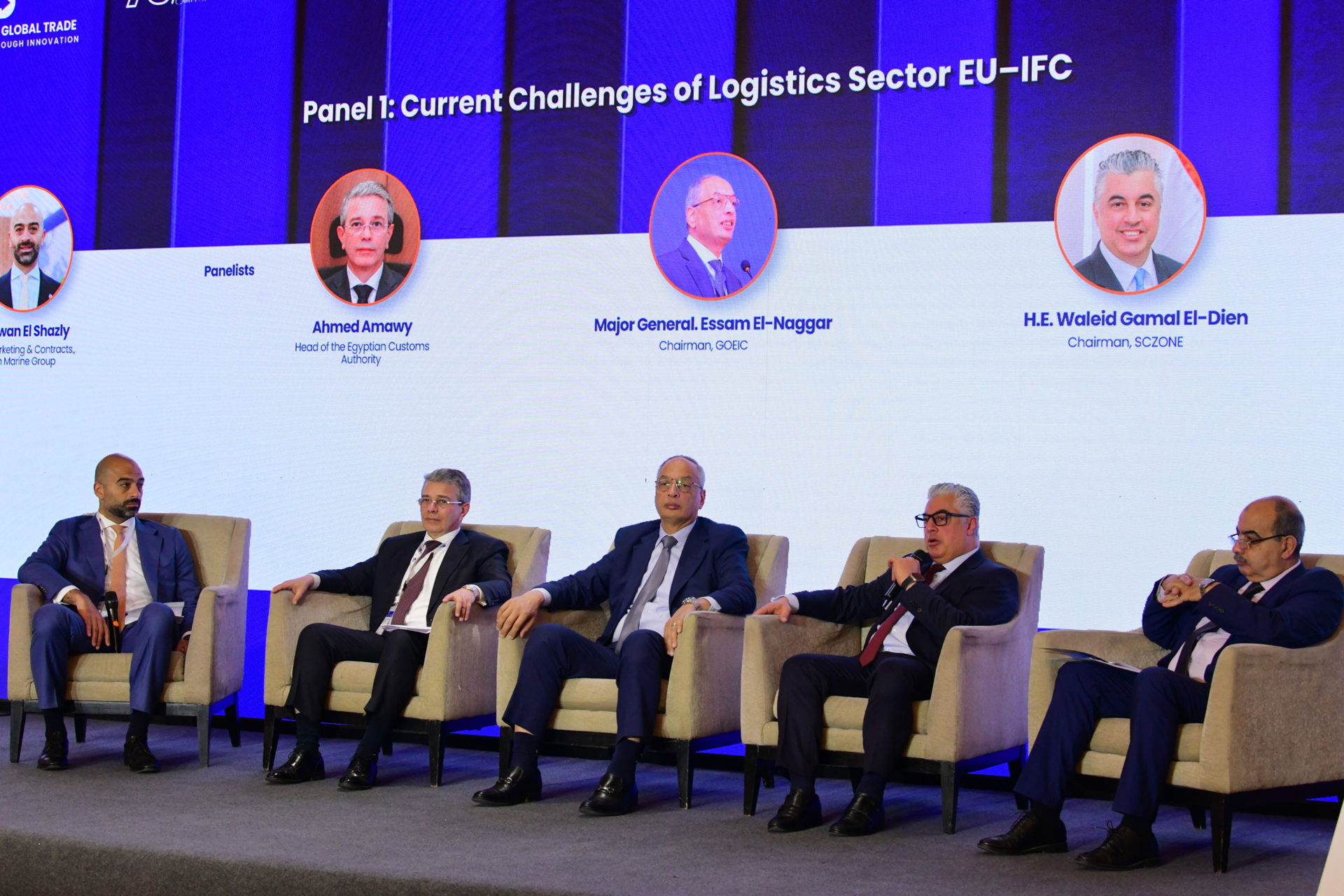
On Tuesday, May 5, the German-Arab Chamber of Industry and Commerce (AHK Egypt) organized a major exclusive conference titled "Egypt – The Gateway to Global Trade | Connecting Continents Through Innovation" at the Triumph Luxury Hotel in Cairo. High-level ministers from the Egyptian government attended the event, and international financial institutions and the private sector participated widely to discuss strategies for transforming Egypt into a global trade and logistics hub.
Ms. Maren Diale-Schellschmidt, AHK Egypt CEO, opened the event by highlighting the resilience of the Egyptian logistics sector. She noted Egypt's 10-place advancement in the World Bank's Logistics Performance Index (LPI) to reach the 57th position globally in 2023. Furthermore, she revealed a 4.6% growth in the bilateral trade volume between Egypt and Germany during the first months of 2026 compared to the previous year.
Meanwhile, in his welcoming speech, Eng. Ahmed Elsewedy, AHK Egypt President , confirmed that massive investments in roads, ports, and railways have strengthened Egypt's competitiveness. He also stressed the chamber's commitment to supporting vocational training, and this effort aims to provide qualified human resources to keep pace with this continuous development.
During his speech, H.E. Mr. Ahmed Kouchouk, Minister of Finance, reviewed a set of strategic legislative and tax reforms, and these reforms aim to transform Egypt into a main regional hub for trade exchange, warehousing, and transit. Kouchouk confirmed this vision, and he stated that logistics success relies basically on a legislative framework to guarantee clarity and predictability for investors. He pointed to a set of about 30 to 40 recent customs and tax measures, and the government has already activated them. These procedures allow the creation of dedicated warehouses for re-exportation and transiting, and they do not impose any extra tolls. Furthermore, the internal movement of cargo between Egyptian ports is exempted from Value Added Tax and any indirect taxes, and this ensures the swift flow of shipments.
Kouchouk supported his statements with statistical data, and this data reflects the actual impact of these facilities. For example, the government exempted transit shipments from the Advance Cargo Information (ACI) requirement, and this resulted in a tangible leap. The quantity of transit movement increased by 50% during the first quarter of this year. He also highlighted the advanced steps in digitalization and governance, and these steps include unifying the units of measurement to avoid any confusion during ACI applications. Additionally, the government collected all customs and tax circulars in one unified electronic platform, and this facilitates access for investors. The Minister concluded his speech by mentioning upcoming legislative amendments, and these amendments will make prior release mandatory. The government will also activate a comprehensive system for risk management, and this system relies on four tracks for customs clearance. These steps aim to shorten the clearance time of shipments at ports, and they match the highest international standards without obstructing trade movement.
On the other hand, H.E. LG. Kamel El-Wazir, Minister of Transport, presented the comprehensive national strategy to transform Egypt into a regional hub, and this plan focuses on transport, logistics, and transit trade. This strategy follows the directives of the political leadership, and it aims to maximize the benefit of the country's unique geographical location. The Minister revealed that the state invested over EGP2 trillion to modernize all transport sectors, and these projects include roads, railways, and ports. He explained that the cornerstone of this strategy is the planning of seven integrated logistics corridors, and these paths link production areas to seaports through fast transport. These corridors rely on a network of dry ports and logistics zones, and they accelerate customs clearance to facilitate supply chains.
Highlighting regional connectivity, the Minister emphasized the importance of these corridors in enhancing international links, and he specifically mentioned the Arish-Taba corridor. This project makes Egypt an essential part of the India-Gulf-Europe-America trade corridor (IMEC), and it transports goods via rail to the Gulf countries through Safaga port. The Minister also highlighted the success of the Ro-Ro line from Damietta to Trieste, and this service secures the arrival of fresh exports to Europe. There are plans to expand the service to Greece, France, and Spain, and the government also seeks to transform Egypt into a regional hub for energy transport. These efforts rely on petroleum pipelines, and they connect to ports and the high-speed electric rail network.
Regarding international partnerships, the Minister of Transport praised the strategic cooperation with major German entities, and he confirmed the alliance led by Siemens. This alliance includes large national companies, and they are currently implementing the high-speed electric rail network. The first line links Ain Sokhna to Alexandria, and this 660-kilometer project will start operating by the end of this year. The Minister emphasized the state's firm commitment to encouraging the private sector, and the government builds the infrastructure with Egyptian funds. Specialized international companies handle management and operation tasks, and five global firms currently manage the six largest port stations. This group includes the German companies Eurogate and Hapag-Lloyd, and they work to enhance the efficiency of Egyptian ports.
Moreover, The conference featured an extensive fireside chat titled "EU-IFC". Ms. Abir Leheta, Group co-CEO Egytrans NOSCO, moderated the session, and it included the participation of Mr. Nikolaos Zaimis, EU Minister Counsellor and Head of Trade Section, and Mr. Saad Sabrah, IFC Country Head for Egypt. During the session, the participants discussed the strategic role of Egypt as a global trade gateway in light of the current crises; Zaimis confirmed this view, and he stated that logistics represents the DNA of the European Union. He also described logistics as a crucial element in the competitiveness of countries. He emphasized the necessity to build resilience instead of looking for the cheapest or fastest options, and this approach provides alternatives and flexible options. He also reviewed the four pillars of the sector, and these include physical, digital, human, and legal infrastructure. He considered the legal infrastructure as the regulating framework, and it acts as the basic glue to bond the system together.
Meanwhile, Sabrah noted the IFC's view of logistics as a competitive and resilience agenda. He mentioned Egypt's massive competitive advantages, and these advantages require converting the geographical location into tangible logistical performance. He explained the massive financing needs in this sector, and the public sector cannot bear them alone. This situation requires mobilizing private sector investments through bankable projects and public-private partnership structures. Furthermore, the session touched upon the importance of digitization and sustainability in the transport sector. The speakers highlighted decarbonization measures, and they focused on the role of blended finance to reduce risks and stimulate investment in the current economic environment.
In addition, the conference featured two panel discussions; the first panel took place under the title "Current Challenges of Logistics Sector". Mr. Marwan El Shazly, VP of Marketing and Contracts at Pan Marine, moderated the session , and it highlighted strategies to handle global supply chain disruptions and changing shipping routes due to current regional tensions.
H.E. Waleid Gamal El-Dein, Chairman of SCZONE, revealed the zone's success , and he stated it attracted massive investments of 60 billion dollars in the last three years and nine months. He considered the current crisis an unprecedented opportunity for the Egyptian maritime and logistics services sector. He pointed to the localization of 8 vital industries , and these include aluminum, pharmaceutical active ingredients, food industries, and electric car batteries. He expected the authority's revenues to increase by at least 30% in the upcoming period. He also confirmed a major fact about Port Said port, and it currently hosts 74% of the transit trade volume in Egypt.
Meanwhile, Mr. Ahmed Amawy, Head of the Egyptian Customs Authority, explained the government's exceptional decisions to support direct transit trade to the Gulf countries. The most prominent decision exempted shipments from the Advance Cargo Information (ACI) requirement , and this served as an urgent solution to accommodate stranded cargo at the high seas. This step resulted in a significant increase in the volume of incoming shipments. He also announced the imminent activation of the TIR agreement , and this will facilitate the transit of Egyptian products to about 80 countries. The authority is also implementing the comprehensive risk management system in cooperation with presentation entities , and this aims to accelerate customs clearance and reduce physical inspection through the pathways system.
In a related context, Major General Essam El-Naggar, Chairman of GOEIC, reviewed the authority's efforts , and these efforts ensure the stable flow of goods without compromising quality standards. He emphasized the role of central laboratories inside the ports to reduce inspection time, and he gave the example of Ain El Sokhna port; this port now includes a complex of 39 industrial laboratories. He pointed to a plan to connect these laboratories electronically , and this relies on an 11-million-dollar grant from South Korea. The authority also launched a platform and a smart assistant to support exporters and facilitate procedures , and this assistant is available in multiple languages including Portuguese and Chinese to expand access to global markets.
Rear Admiral Dr. Rafik Galal, CEO of Damietta Container and Cargo Handling Company, concluded the discussion by confirming the proactive readiness of Egyptian ports to accommodate successive developments. He explained the Damietta terminal's current reliance on the latest global operating systems (TOS M4) to enhance automation. He revealed the launch of an international distribution center inside the terminal , and this facilitates transit trade in cooperation with the Customs Authority. This step reflected on the company's operational performance, and it contributed to gaining the trust and partnership of 9 out of the 10 biggest global shipping line companies.
The conference included two info sessions, and they highlighted innovative logistical solutions and the developments of mutual regional initiatives. Mr. Marwan El Shazly, VP of Marketing and Contracts at Pan Marine Group, presented the first session, reviewing the details of the group's RORO Service Network. El Shazly revealed the remarkable development of the fast shipping line for RORO services which launched in November 2024 to connect Damietta port in Egypt and Trieste in Italy. This line aims to form a commercial bridge between Egypt and Europe, and it supports the export flow of fresh produce, automobile car parts, and textiles. He explained a key detail about the sailing time, and the trip takes only two and a half days to reach the Italian port. This fast service allows the delivery of goods to German markets, and they can specifically reach Munich in four to five days.
The presentation highlighted the exceptional government facilities to ensure the project's success, and these included accepting only the insurance certificate instead of the letter of guarantee. This step enhanced the efficiency of operational processes inside the company's dedicated terminal in Damietta, and this facility includes a dock of 250 meters. The terminal also features dedicated x-ray machines and more than 280 reefer trucks, and it operates as a one-stop location to finalize all procedures. El Shazly also pointed to the pivotal role of the group's Mina line, and this line connects Europe to the Gulf countries through the Safaga and Duba route. The company operates four trips per week on this route, and this reduced the cargo transport time from Germany to Dubai to only eight days. The same trip took 18 to 21 days before the outbreak of the regional crisis and the change of shipping routes. This corridor became a strong competitor to air freight, offering close transit times and an increased capacity.
The second info session took place under the title "MED-GEM CBAM & EU Help Desk"; Mr. Ali Habib, Country Correspondent , presented this session.
The conference concluded with the second panel discussion under the title "New Era of Logistics Digitalization". Dr. Ahmed Elbeltagui, Transport, Energy & Climate Sector Manager at the EU Delegation, moderated this session. At the beginning of the session, Elbeltagui pointed out Egypt's massive capabilities and advanced digital infrastructure, includeing the NAFEZA customs platform and phase 1 of the intelligent transport system (ITS), and he described it as the digital nervous system of the transport network. He also confirmed the importance for the rest of the technological ecosystem to keep pace with this rapid development. Eng. Gamal Kotb, General Manager of Misr Technology Services (MTS), reviewed the success of the NAFEZA platform. This platform reduced the average customs clearance time from 29 days in 2021 to 9 days. Recently, the time hovered over about 13 days due to geopolitical challenges and foreign currency difficulties. He explained the platform's connection with more than 35 government agencies, and it handles about 5,000 shipments a day. Operations now rely completely on electronic archives and digital transactions, but there is a current reliance on the paper bill of lading and certificate of origin. He revealed real serious steps to issue electronic bills of lading soon. Kotb revealed the move towards smart customs using AI to classify goods. He also mentioned the direction to integrate NAFEZA with other similar global single windows.
Meanwhile, Mr. Vjeran Ortynski, VP of CargoX participated virtually, and he confirmed Egypt's advanced position ahead of many global markets in digital trade document practices. He attributed this progress to the Advance Cargo Information (ACI) system and the NAFEZA platform. He pointed out the main global challenge for electronic bill of lading (eBL) adoption. This challenge does not lie in the technology itself, but it involves the multiple parties in the broader trade ecosystem and the need to align processes. He emphasized the role of blockchain technology as a neutral interoperability layer, and this layer allows data exchange between global customs authorities to create digital trade corridors without interfering with sovereign systems' control over their data. In the same context, Mr. Ossama Ibrahim, Country Manager of DHL Express Egypt, pointed to the necessity of closing the gap between regulation, digitalization, and implementation on the ground; he gave an example of the continuous 100% physical inspection procedures for shipments despite the availability of advanced x-ray machines. He called for aligning the Egyptian customs codes with global standards to accelerate the pace of customs clearance, and he noted the existence of 28,000 local codes compared to only 6,000 global HS codes. He also announced the company's investment expansions in Egypt, and these plans include allocating a 12,000 square meter area as a distribution center in Cairo. He confirmed the positive impact of the electronic data interchange (EDI) integration with MTS, and this integration will reduce the customs clearance time for express shipping services by 25% to 30%.
Furthermore, Mr. Mohammed El Negily, ICT and Digital Transformation Expert at Elsewedy Electric T&D for the ITS Project, discussed the role of intelligent transport systems. These systems lower supply chain costs and reduce fuel use, and they make Egypt a more attractive destination for investments. He explained the biggest operational challenge in joint coordination between multiple stakeholders like the Ministries of Interior, Transportation, and Defense. This coordination is needed to integrate different technical systems for multiple vendors and to ensure site readiness for the road network. He announced the coverage of 6 major roads in the first phase of the project, and this phase will be finished by the end of this year. A unified platform in the command control center in the new administrative capital will manage this network centrally. This step represents a starting point to connect all ports, industrial zones, and roads with a smart network across the country.
This conference comes at a strategic time, and the global supply chain sector currently faces unprecedented challenges. The conference confirms the state's relentless efforts, and these endeavors aim to establish Egypt as a regional logistics and trade hub. The concluding insights of the conference highlight an important fact, and reaping the benefits of Egypt's massive infrastructure now requires deeper public-private partnerships. The country must also expand comprehensive digitalization, and this step ensures the sustainability and resilience of trade movement. These combined efforts will place the Egyptian market at the forefront, and Egypt will shape the future of global logistics standards in the upcoming period.
In conclusion, the German-Arab Chamber of Industry and Commerce (AHK Egypt) expresses special thanks and appreciation to the partners and sponsors for their effective contribution for making this conference a successful event. The list of Platinum Sponsors includes CIB Egypt and Misr Technology Services, and PAN MARINE GROUP participated as the Gold Sponsor. Furthermore, EgyMar Shipping & Logistics Services S.A.E and Deraya Insurance Brokerage provided their support as Silver Sponsors. This outstanding backing reflects the commitment of major economic entities to support the state's vision, and it confirms the joint efforts to advance the logistics sector and enhance the competitiveness of the Egyptian economy.